

Our History
The Hands That Built the Fort
On November 18, 1938, at the height of the Great Depression, a crew of 83 local men picked up their hammers and went to work. Funded through a partnership between the federal Works Progress Administration (WPA) and Kern County, this workforce brought together men at every stage of life under the guidance of carpentry supervisor Holmer W. House.
Together, they set out to construct a grand replica of Sutter’s Fort—California’s famous 1839 pioneer outpost in Sacramento. Using rustic architectural methods designed to evoke 19th-century frontier life, these men transformed raw materials into a lasting monument for the West Side.
“Most of them were unskilled, too young to have any experience or too old to hold a job in competition with younger men. However, they all worked together and accomplished a construction which would have passed inspection by a severe inspector. It is hard to describe the pride the men took in their creation.” — Holmer W. House, Supervisor
That pride still lingers here today—whispering through the olive trees, echoing in the central courtyard, and standing tall in the enduring spirit of Taft.
16:21 minute video about the original Sutter’s Fort that our Fort was modeled after.
4:19 minute video about the WPA
Write About It:
Have you ever been told you were 'too young' or 'not ready' to do something you really wanted to try? How did that feel? When the 83 men built the Fort, many of them had been told the exact same thing. How do you think it felt when they finally got to build something huge together and prove everyone wrong?
Hands On Activity:
Walk the Fort courtyard (or inspect detailed photos) with a magnifying glass or clipboard. Find 3 places where human hands left their mark, such as tool marks in heavy timber, uneven hand-molded bricks, or unique carpentry joints.
1938–1940: Built by the People, for the People
Constructed as part of President Franklin D. Roosevelt’s New Deal, the Taft Fort was designed to tackle two crises at once: providing immediate relief wages to struggling local families and creating a permanent public resource. WPA workers molded adobes, framed heavy timbers, and crafted detailed woodwork by hand.
When it opened in 1940, the Fort stood as a symbol of economic resilience, civic pride, and hope. It served a dual purpose from day one: honoring California's early pioneer heritage while providing a modern, multi-use community center for the people of Kern County.
Write About It:
Which part of the brick-making process would you most want to help with—digging the soil, stomping the wet mud, packing the heavy wooden molds, or turning the drying bricks in the sun? Using the role you choose, write a paragraph describing a workday at the Fort in 1938. What would you hear, smell, feel, and see as you and your crew worked together under the hot Taft sun?
8:49 minute video detailing how adobe bricks are made.
1940s–1970s: The Heart of Civic & Cultural Life
Throughout the mid-20th century, the Fort served as the vibrant epicenter of West Side social life. During WWII and the post-war boom, its hall and courtyard hosted everything from official civic meetings and agricultural displays to Scout troops, school field trips, and town dances.
It became an essential living-history classroom for generation after generation of local students, teaching California’s frontier past while fostering a deep sense of community identity during Taft's booming petroleum era.
Hands On Activity:
In 1938, the WPA funded the Fort to create jobs during the Great Depression, but building costs look very different today. Step into the role of a project planner and calculate what it would cost to construct a simple 10-foot by 10-foot historic room using modern prices!
13:12 minute video about America post World War II.
3:26 minute video of the types of dances seen at the Fort Auditorium
5:03 minute video about the New Dea
Write About It:
Think about a place in your hometown where everyone gathers; a park, a diner, or a community center. Write a short reflection on what makes a physical building feel like 'the heart' of a town. What memories do you think local Taft teenagers made at the Fort dances in the 1950s that are similar to how you connect with friends today?
Hands On Activity:
Using paper and markers (or a digital tool like Canva), create a 1950s-style promotional poster for a Scout jamboree, town dance, or parade happening in the Fort courtyard.
1980s–2000s: Preservation & Grassroots Rescue
By the late 20th century, shifts in municipal budgets and changing demographics left the aging wooden and adobe structure vulnerable to disrepair. When a series of earthquakes from the San Andreas Fault struck the area in the late 1980s, the aging structure suffered new structural cracks and masonry damage. Facing both natural disasters and dwindling public funds, local heroes formed the Fort Preservation Society; rallying the community to repair the seismic damage and secure the Fort on the National Register of Historic Places.
Through relentless volunteer labor, grassroots fundraising drives, and historical advocacy, the Society secured key preservation status, restored deteriorating structures, and ensured the landmark remained protected for future generations.
6:24 minute video about non-profit organizations
2:09 minute video about the San Andreas Fault.
Write About It:
If a historic building in your neighborhood was about to be torn down or abandoned, would you fight to save it? What are the pros and cons of saving it? Write a persuasive letter to the local city council explaining your position on the topic.
Hands On Activity:
Walk the Fort courtyard (or inspect detailed photos) with a magnifying glass or camera. Find 3 places where human hands left their mark, such as tool marks in heavy timber, uneven hand-molded bricks, or unique carpentry joints.
Today: A Living Monument
Today, the Fort is experiencing a dynamic revival. No longer just a monument to the past, it has evolved into a thriving community venue, hosting weddings, regional cultural festivals, vendor fairs, and educational programming.
With renewed stewardship and ongoing restoration efforts, the Fort bridges Taft’s historic roots with its modern future: a place where history is not just remembered, but actively lived.
8:38 minute video about why historical preservation matters.
8:42 minute video of the Fort grounds today.
Hands On Activity:
Research the rules for fixing or renovating a nationally recognized historical building. What is the main rule regarding replacing historic materials vs. repairing them? Why can't a contractor use modern materials? Then look up 2 or 3 local general contractors or restoration specialists. Call or email them (or script a mock interview) with these questions: "Do you have experience working on buildings on the National Register of Historic Places?" "Are your workers trained in Secretary of the Interior Standards for Historic Rehabilitation?" "Can you match original 1938 wooden timber construction techniques?"
Write About It:
Look around the Fort courtyard today. History isn't just dead facts in a textbook; it's alive in the events, weddings, and markets hosted here. How do you feel when you stand in a space built almost a century ago? How does knowing the history of the 83 men who built it change how you experience this place today?
Looking for More?
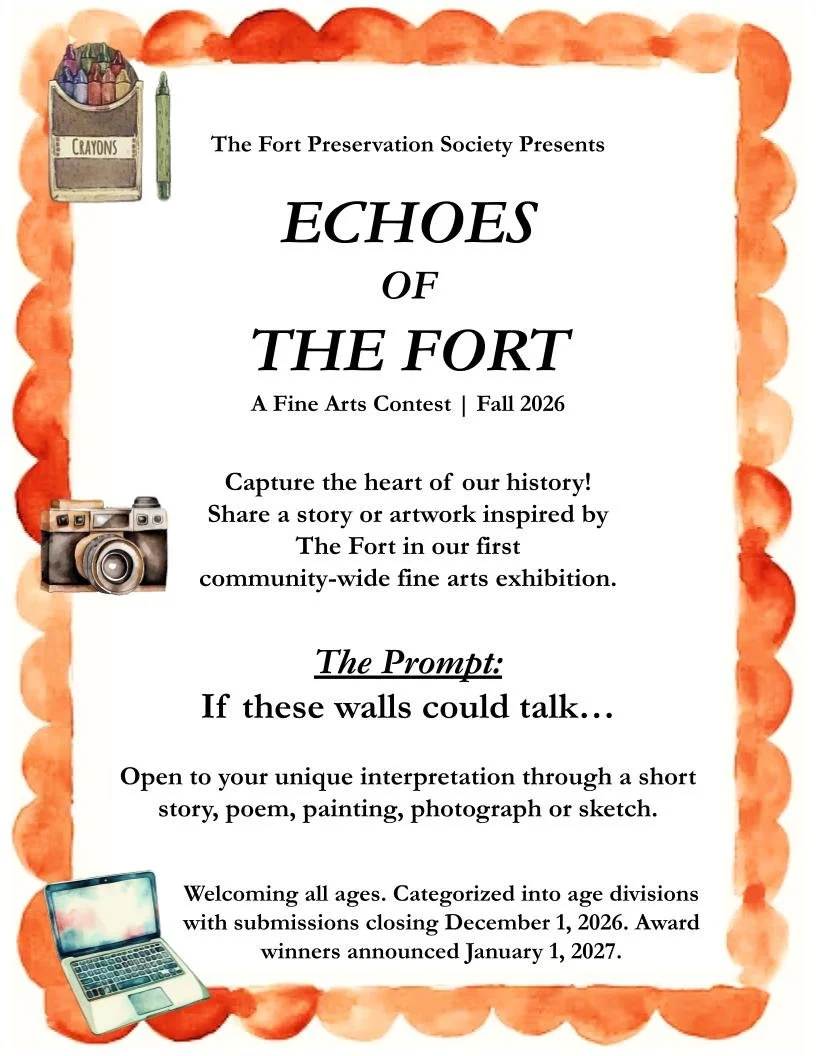
Submit via email: TaftHistoricFort40@gmail.com
Include your name, age, and phone number in your email, as well as a short artist’s statement about your piece.